






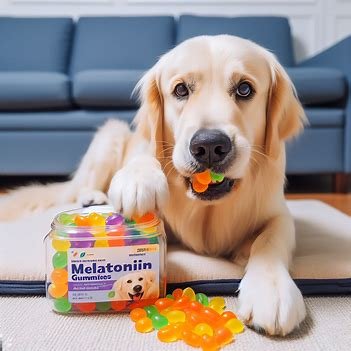
⚡ Quick answer: No — and the format is the problem, not the melatonin. Vets do prescribe melatonin to dogs for certain conditions. But gummies and chewables are among the most common household sources of xylitol, they are dosed for a 70 kg adult, and they taste like sweets. Check the ingredients before anything else.
⚠️ Check the ingredients for xylitol now
Gummy supplements are frequently sweetened with xylitol or birch sugar, which causes a life-threatening drop in a dog’s blood sugar within 10–30 minutes. If it is on the label, call a vet immediately and say the word xylitol. If not, the melatonin dose is the next thing to work out.
The short answer
No, not the gummies. This one needs separating into two questions, because they have different answers.
Melatonin as a drug has genuine veterinary uses. Vets prescribe it for noise phobia, some sleep and anxiety problems, and a form of seasonal hair loss called alopecia X. Given at an appropriate dose it is generally well tolerated.
Melatonin gummies as a product are a different matter. They are sweets in every practical sense — soft, flavoured and appealing — and they are frequently sweetened with xylitol. A dog that finds a tub can eat a great many very quickly, and the xylitol is a far more urgent problem than the melatonin.
There is also a dosing issue. Human gummies are formulated for adults, often at 5 or 10 mg, which is well above what a small dog would be prescribed.
Table of Contents
Why melatonin gummies is dangerous for dogs
The compound responsible: Xylitol in many gummy formulations — the principal danger. Melatonin itself is comparatively benign; some products also contain 5-HTP, which is not.
Xylitol triggers a powerful insulin release from a dog’s pancreas — a response humans do not have. Blood glucose can crash within 10 to 30 minutes, and doses above roughly 0.5 g/kg cause acute liver failure. This is the reason gummies are dangerous, and it has nothing to do with melatonin.
Melatonin itself has a wide safety margin in dogs. Overdose typically causes sedation, wobbliness and digestive upset rather than anything life-threatening — though a very drowsy small dog is still worth a call.
Some sleep gummies contain 5-HTP as well, and that is genuinely toxic to dogs. It causes serotonin syndrome — tremors, hyperthermia, seizures — at doses starting around 23.6 mg/kg. Read the full ingredient list, not just the front of the tub.
Melatonin products may also contain other actives: valerian, chamomile, magnesium, or added vitamins including iron, which is toxic in quantity.
How much melatonin gummies is dangerous?
The number that matters depends entirely on what is in the product. Work through these in order.
For reference, xylitol causes hypoglycaemia at around 0.1 g/kg and liver failure above 0.5 g/kg. A xylitol-sweetened gummy may contain anywhere from 0.2 to 1 g.
| Ingredient found on the label | Concern | What to do |
|---|---|---|
| Xylitol / birch sugar / E967 | Emergency | Call a vet immediately; say the word xylitol |
| 5-HTP | Emergency | Call a vet; serotonin syndrome risk |
| Iron or added minerals | Moderate to high | Call a vet with the amount |
| Melatonin only, a few gummies | Low to moderate | Expect sedation; call if a small dog or a large number |
| Melatonin only, a whole tub | Moderate | Call a vet — the sugar and gelatine load matter too |
| Sugar-free of any kind | Treat as emergency until checked | Sugar-free usually means a sugar alcohol; verify which |
A whole tub is the realistic scenario. Gummies are soft and sweet and dogs do not stop at one, so exposures tend to be large rather than single-dose.
Even xylitol-free gummies carry a substantial sugar load, and the gelatine mass from a whole tub can cause digestive upset or, rarely, an obstruction.
Do not give a human melatonin gummy to a dog as a calming aid. If melatonin is appropriate for your dog, ask a vet for a dose and a suitable product.
Symptoms to watch for
Xylitol within 10 to 30 minutes, occasionally delayed up to 12 hours. Melatonin sedation within one to two hours. Liver injury from xylitol at 24 to 72 hours.
Early signs
- Drowsiness and sedation — expected from melatonin itself
- Wobbliness or an unsteady gait
- Vomiting
- Digestive upset
Signs of serious poisoning
- Weakness, collapse, tremors or seizures — suggesting xylitol and low blood sugar
- Disorientation
- Jaundice, appearing days later — liver injury from xylitol
- High body temperature, agitation and tremors — suggesting 5-HTP
- Bruising or bleeding — clotting failure in liver damage
Mild drowsiness after melatonin is expected. Weakness, staggering or seizures are not — those point to xylitol and need immediate veterinary attention.
What to do if your dog has eaten melatonin gummies
- Read the full ingredient list for xylitol, birch sugar and 5-HTP. Do this before anything else.
- If either is present, call a vet immediately and name the ingredient.
- Count how many gummies are missing and check the milligrams per gummy.
- Take the tub with you if you go in.
- If it is melatonin only, expect drowsiness and call for advice if your dog is small, very sedated, or ate a large number.
What not to do
- Do not give human melatonin gummies to a dog as a calming aid. Ask a vet for an appropriate dose and product.
- Do not assume sugar-free means safe — it usually means a sugar alcohol, and sometimes xylitol.
- Do not wait for symptoms if xylitol is on the label.
- Do not leave supplement tubs on bedside tables or in handbags.
How vets treat it
If xylitol is involved, treatment is intravenous dextrose to correct and maintain blood glucose, with frequent monitoring, plus liver values checked for 72 hours and liver protectants such as SAMe.
For 5-HTP, treatment is decontamination where recent, plus cyproheptadine, sedation and active cooling for serotonin syndrome.
For melatonin alone, most dogs simply need observation until the sedation wears off. Fluids and anti-nausea medication may be given for digestive upset.
Prognosis is good with prompt treatment in all three cases. The xylitol cases are the ones where delay changes the outcome.
Dogs at higher risk
The risk here scales with the format and the dog’s size.
- Small dogs and puppies — one xylitol-sweetened gummy can be a toxic dose
- Toy breeds prone to hypoglycaemia, such as Yorkshire Terriers and Chihuahuas
- Dogs with liver disease
- Dogs on antidepressants or other serotonergic drugs — additive risk with 5-HTP
- Diabetic dogs — both the sugar and the insulin effect matter
Where dogs usually get hold of melatonin gummies
Supplement gummies are stored where dogs can reach them far more often than medication is.
- Bedside tables — where sleep supplements naturally live
- Handbags left on the floor
- Kitchen worktops and open shelves
- Tubs with child-resistant lids, which are not dog-resistant
- Owners giving them deliberately to calm a dog
- Guests’ luggage and washbags
- Children’s vitamin gummies, which have the same problem
What to give instead
If the goal is a calmer or better-sleeping dog, there are approaches that work without a tub of sweets in the bedroom.
- Prescription melatonin at a veterinary dose, if your vet thinks it suits your dog — the drug is fine, the gummy is not
- Veterinary calming supplements such as alpha-casozepine or L-theanine products formulated for dogs
- Pheromone diffusers
- Prescription anxiety medication for genuine noise phobia or separation anxiety — far more effective than a supplement
- A predictable routine, more daytime exercise and enrichment — often the actual answer for a restless dog
- A frozen stuffed Kong at bedtime to settle a dog that struggles to wind down
Frequently asked questions
Are melatonin gummies safe for dogs?
No. Melatonin itself is used in dogs under veterinary direction, but gummies are frequently sweetened with xylitol, which causes a life-threatening drop in blood sugar. Some sleep gummies also contain 5-HTP, which is genuinely toxic. Check the full ingredient list.
How much melatonin is safe for a dog?
That is a question for your vet, who will base it on your dog’s weight and the reason for giving it. Do not work it out from a human product — human gummies are typically 5 or 10 mg, formulated for an adult, and the format carries risks the melatonin does not.
My dog ate a whole tub of melatonin gummies. What now?
Read the ingredients for xylitol, birch sugar or 5-HTP and call a vet immediately if either appears. If it is melatonin only, still call — a whole tub is a large sugar and gelatine load as well as a large melatonin dose. Take the tub with you.
What does xylitol do to dogs?
It triggers a massive insulin release, crashing blood sugar within 10 to 30 minutes. Above roughly 0.5 g/kg it also causes acute liver failure. Dogs are uniquely susceptible — humans and cats do not show this response.
Is 5-HTP dangerous for dogs?
Yes. It causes serotonin syndrome — tremors, high body temperature, agitation and seizures — from around 23.6 mg/kg. It appears in some sleep and mood supplements alongside melatonin, so read the whole ingredient list.
My dog seems very sleepy after eating melatonin. Is that expected?
Mild drowsiness is the expected effect of melatonin and usually passes within a few hours. Weakness, staggering, tremors or seizures are not expected and suggest xylitol — that needs immediate veterinary attention.
The bottom line
The melatonin is rarely the problem. The gummy is. These products are sweets that live on bedside tables, they are frequently xylitol-sweetened, and dogs do not stop at one.
If your dog has got into a tub, the first thing to do is read the ingredient list rather than look up melatonin doses — xylitol and 5-HTP are the two words that change what happens next.
And if you actually want melatonin for your dog, ask a vet. The drug has real uses in dogs; the format sold for humans is simply the wrong way to deliver it.
References
- Plumb’s Veterinary Drug Handbook, 10th edition.
- Murphy LA, Coleman AE. Xylitol toxicosis in dogs. Veterinary Clinics of North America: Small Animal Practice 2012;42(2):307–312.
- Gwaltney-Brant SM, Albretsen JC, Khan SA. 5-Hydroxytryptophan toxicosis in dogs: 21 cases (1989–1999). Journal of the American Veterinary Medical Association 2000;216(12):1937–1940.
- ASPCA Animal Poison Control Center. Toxicology case data and species-specific guidance.
- Merck Veterinary Manual. Toxicology of food-associated hazards.
This article is informational and does not replace veterinary advice. If you are worried about your dog, contact your own vet or one of the poison lines listed above — that call is always the right call.


