







Why Patellar Luxation Is The Small-Breed Equivalent Of Hip Dysplasia
Patellar luxation is one of the most common orthopaedic conditions in small and toy breed dogs — dislocation of the kneecap (patella) from its normal position in the trochlear groove of the femur. Most cases are congenital / developmental with conformational abnormalities:
- Shallow trochlear groove
- Medial deviation of the tibial tuberosity
- Bowing of femur or tibia
- Hypoplastic medial femoral condyle
- Soft tissue laxity around the joint
Traumatic patellar luxation is rare. Most cases are bilateral (~50%) and present in young dogs.
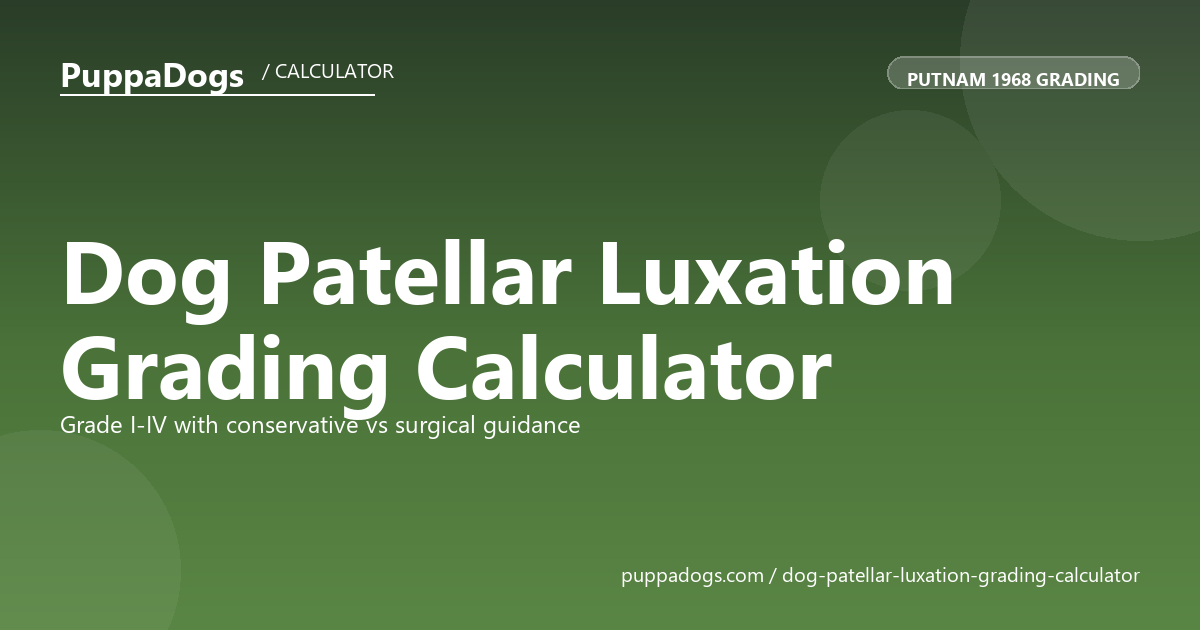
This calculator applies the Putnam 1968 4-grade system — the international standard — and translates each grade into the treatment framework.
The Putnam 4-Grade System
| Grade | Definition | Treatment |
|---|---|---|
| I | Patella can be manually luxated but returns to normal spontaneously | Usually monitor; lean body condition |
| II | Patella luxates intermittently; spontaneous reduction or with manipulation | Conservative if minimal signs; surgical if meaningful signs |
| III | Patella permanently luxated but can be reduced manually | Surgical correction generally recommended |
| IV | Patella permanently luxated; cannot be reduced manually | Surgical correction strongly recommended |
Grade assignment is by vet orthopaedic examination — they manipulate the patella in flexed and extended positions, with the leg in various rotations, to assess luxation tendency.
Direction Matters
Medial Patellar Luxation (MPL)
- About 80% of cases
- Patella displaces toward the inside of the leg
- Small / toy breed pattern — Yorkie, Pomeranian, Chihuahua, Toy Poodle, Maltese, Boston Terrier, Cavalier King Charles, Shih Tzu, Pekingese, Bichon Frise, French Bulldog
- Often bilateral
- May be silent in Grade I or symptomatic in Grade II+
Lateral Patellar Luxation (LPL)
- About 20% of cases
- Patella displaces toward the outside of the leg
- Large / giant breed pattern — Labrador, Golden, Saint Bernard, Newfoundland, Great Dane, Akita, Mastiff
- Often associated with hip dysplasia — the rotational forces from hip laxity contribute
- Tends to be more severe (Grade III/IV)
Classic Clinical Signs
The most recognisable owner-visible signs:
Skipping Gait
The hallmark sign. Dog walks normally, then suddenly carries one hind leg up for a step or two, then puts it back down. This corresponds to the patella luxating out, then reducing back into position during ambulation. Often described as “skip-running” or “three-legged hopping”.
Intermittent Lameness
Episodic — fine for days then suddenly limping for hours, then fine again. Frustrating for owners and easy to miss between episodes.
Reluctance For Activity
- Reluctance to jump, climb stairs, run
- Stops mid-walk
Bow-Legged Appearance (Severe)
Grade III/IV in young growing dogs leads to progressive skeletal deformity — the femur and tibia deform around the abnormally tracking patella as the dog grows. Result: visibly bow-legged conformation, crouched gait.
Breed Predispositions
Small / Toy Breeds (Medial Luxation)
- Yorkshire Terrier — top of the list
- Pomeranian
- Chihuahua
- Toy Poodle / Miniature Poodle
- Maltese
- Boston Terrier
- Cavalier King Charles Spaniel
- Shih Tzu
- Pekingese
- Bichon Frise
- French Bulldog
For these breeds, routine vet examination of the knees at every annual visit catches Grade I cases that the owner may not notice.
Large Breeds (Lateral Luxation)
- Labrador Retriever
- Golden Retriever
- Saint Bernard
- Newfoundland
- Great Dane
- Akita
- Mastiff
For these breeds, lateral luxation is often associated with hip dysplasia — consider hip-extended radiographs as well.
Treatment By Grade
Grade I – Usually No Treatment
- Asymptomatic in most cases
- Maintain lean body condition (BCS 5)
- Monitor for progression — about 30% progress to higher grade over time
- Risk factors for progression: large size, obesity, trauma, repeated subluxation episodes
Grade II – Decision Point
Conservative if minimal signs:
- Weight management, controlled exercise, NSAIDs for flares
- Physiotherapy for muscle balance
- Many Grade II cases functional throughout life
Surgical if meaningful signs:
- Repeated skipping episodes affecting quality of life
- Worsening over time
- Young dog with prospects of decades of disease
Grade III – Surgical Correction Generally Recommended
- Permanently luxated patella causes chronic abnormal stress
- Progressive osteoarthritis without surgery
- Conformational changes in young growing dogs (early surgery prevents)
- Most cases benefit from surgical realignment
Grade IV – Surgical Correction Strongly Recommended
- Most severe form
- Usually requires specialist orthopaedic referral
- Complex surgery — may include femoral or tibial corrective osteotomy in severe deformity cases
- Early surgery in growing dogs prevents progression
Surgical Procedures
The standard surgical correction usually combines several procedures:
Trochlear Groove Deepening
Deepens the femoral trochlear groove to better hold the patella. Multiple techniques:
- Block recession trochleoplasty — chunk of cartilage removed, replaced deeper
- Wedge recession trochleoplasty — wedge of cartilage removed, replaced deeper
- Abrasion trochleoplasty — removes articular cartilage to deepen (less preferred; loses articular surface)
Tibial Tuberosity Transposition (TTT)
Moves the tibial tuberosity (where the patellar ligament attaches) laterally for medial luxation, or medially for lateral luxation, to realign patellar tracking.
Soft Tissue Reconstruction
- Lateral imbrication — tightens lateral joint capsule for medial luxation
- Medial release — releases tight medial joint capsule for medial luxation
- (Reversed for lateral luxation)
Complex Cases (Grade IV With Bony Deformity)
- Distal femoral osteotomy — corrects femoral varus or valgus deformity
- Tibial corrective osteotomy — corrects tibial bowing
- Requires specialist orthopaedic surgeon
Surgical Timing In Growing Dogs
Critical concept: for Grade III/IV in young growing dogs, early surgical correction (before skeletal maturity at 9-12 months) prevents progressive skeletal deformity. The femur and tibia will deform around an abnormally tracking patella as the dog grows.
Don’t wait for skeletal maturity in young Grade III/IV cases — by the time the dog is fully grown, the conformational deformity may require much more complex corrective surgery (osteotomies).
Cost And Recovery
Surgical Cost
- General practice: GBP 2,000-4,000 / USD 2,500-5,000 per knee
- Specialist orthopaedic centres: typically higher
- Bilateral surgery is usually staged (one knee, 8-12 weeks recovery, then other)
Recovery
- Strict rest 6-8 weeks — crate rest, lead-walked toilet only
- Gradual return to activity weeks 8-12
- Full function 3-4 months
- Physiotherapy / hydrotherapy substantially improves outcomes
- NSAID for pain management
Conservative Management
For Grade I/II cases where surgery isn’t pursued:
- Lean body condition (BCS 5) — reduces load on knee
- Controlled exercise — daily moderate predictable activity
- NSAID for flare-ups — carprofen, meloxicam, Galliprant, firocoxib
- Omega-3 supplementation (joint indication: 100-150 mg/kg/day combined EPA+DHA)
- Physiotherapy — strengthen surrounding musculature
- Avoid jumping from heights — sofa, bed, car
Long-Term Outcomes
Surgical Cases
- Grade I-II surgical correction: excellent outcomes; >90% return to good function
- Grade III surgical correction: very good outcomes; 75-90% return to good function
- Grade IV surgical correction: good but more variable; depends on bony deformity extent
Conservative Management
- Grade I asymptomatic: many remain asymptomatic for life
- Grade I symptomatic: variable
- Grade II: progressive in some cases
- Grade III/IV without surgery: progressive disability, chronic pain, secondary osteoarthritis
Concurrent CCL Disease
Patellar luxation in larger breeds is often associated with CCL disease — the abnormal patellar tracking creates rotational forces that stress the cranial cruciate ligament. Many large-breed patellar luxation cases present with both conditions, and vets often investigate both during orthopaedic examination.
For a CCL-specific assessment, see the PuppaDogs CCL Pre-Test Calculator.
Honest Caveats
- Grade assignment requires vet orthopaedic examination — palpation of the patella in flexed and extended positions.
- Owner-rated severity is approximate — clinical signs don’t always correlate perfectly with anatomical grade.
- Some Grade I cases are silent throughout life; some Grade II cases are dramatically symptomatic — clinical signs guide treatment as much as grade.
- Surgical decision-making for Grade II is nuanced — depends on age, lifestyle, signs severity, owner finances.
- Specialist orthopaedic input is valuable for Grade III/IV and complex cases.
- This calculator helps you understand the framework, not replace examination.
Conclusion
Canine patellar luxation is the small-breed equivalent of hip dysplasia — common, congenital / developmental, often bilateral, with the Putnam 4-grade system driving treatment decisions. Grade I usually monitored; Grade II is the decision point (conservative vs surgical depending on signs); Grade III usually surgical; Grade IV strongly surgical, especially in growing dogs to prevent skeletal deformity. For at-risk small breeds (Yorkie, Pomeranian, Chihuahua, Toy Poodle and others), routine vet examination of the knees at every annual visit catches early cases. With appropriate management, most patellar luxation dogs have good long-term function and quality of life.
Frequently Asked Questions
What is patellar luxation in dogs?
Patellar luxation is dislocation of the kneecap (patella) from its normal position in the trochlear groove of the femur. Most cases are CONGENITAL / DEVELOPMENTAL with conformational abnormalities: shallow trochlear groove, medial deviation of tibial tuberosity, bowing of femur or tibia. Traumatic patellar luxation is rare. Most common in small and toy breeds (Yorkie, Pomeranian, Chihuahua, Toy Poodle, Maltese, Boston Terrier). About 50% of cases are bilateral. The Putnam 4-grade system (I-IV) is the international standard for grading severity.
What are the grades of patellar luxation?
Putnam 1968 4-grade system: GRADE I – patella can be manually luxated but returns to normal spontaneously when released (usually asymptomatic, monitor). GRADE II – patella luxates intermittently with spontaneous reduction or manipulation, classic ‘skipping gait’ (conservative if minimal signs, surgical if meaningful). GRADE III – permanently luxated but can be reduced manually (surgical correction generally recommended). GRADE IV – permanently luxated, cannot be reduced (surgical correction strongly recommended, especially in growing dogs).
Why does my small dog skip a step?
The skipping gait – where a dog walks normally then suddenly carries one hind leg up for a step or two then puts it back down – is the HALLMARK SIGN of patellar luxation (Grade II most often). It corresponds to the kneecap luxating OUT of the trochlear groove and then reducing back into position. The dog skips the affected step because the knee can’t bear weight when the patella is dislocated. Vet orthopaedic examination confirms the Putnam grade.
Does patellar luxation surgery work?
Yes – surgical correction has high success rates. Grade I-II surgical correction: excellent outcomes, more than 90% return to good function. Grade III surgical correction: very good outcomes, 75-90% return to good function. Grade IV surgical correction: good but more variable, depending on bony deformity extent. Standard procedure combines trochlear groove deepening + tibial tuberosity transposition + soft tissue reconstruction. Cost GBP 2000-4000 / USD 2500-5000 per knee at general practice. Recovery: 6-8 weeks strict rest, full function in 3-4 months.
Which dog breeds get patellar luxation most often?
Small / toy breeds with MEDIAL patellar luxation (most common, ~80%): Yorkshire Terrier (top), Pomeranian, Chihuahua, Toy Poodle, Miniature Poodle, Maltese, Boston Terrier, Cavalier King Charles Spaniel, Shih Tzu, Pekingese, Bichon Frise, French Bulldog. Large breeds with LATERAL patellar luxation (~20%): Labrador Retriever, Golden Retriever, Saint Bernard, Newfoundland, Great Dane, Akita, Mastiff – often associated with hip dysplasia. For at-risk breeds, routine vet knee examination at every annual visit catches early cases.
Should my dog with mild patellar luxation have surgery?
Depends. Grade I cases are usually monitored – many remain asymptomatic for life; about 30% progress over time. Grade II is the decision point: if MINIMAL clinical signs and dog functions well – conservative (weight management, controlled exercise, NSAIDs for flares) is reasonable. If MEANINGFUL signs (regular lameness, quality of life impact) – SURGICAL CORRECTION typically gives best long-term outcome, especially in young dogs facing decades of disease. Grade III/IV is generally surgical, particularly in growing dogs where early surgery prevents progressive skeletal deformity.
Related PuppaDogs Calculators
Continue building your dog’s personalised care plan with these related PuppaDogs calculators:
- Dog Pregnancy / Whelping Due-Date Calculator
- Puppy Weight Predictor (Adult Weight Calculator)
- Heatstroke Risk Calculator for Dogs
- Bloat (GDV) Risk Calculator for Dogs
- Dog Life Expectancy Calculator (Breed, Body Condition, Lifestyle)
- Spay/Neuter Timing Calculator for Dogs (Breed-Specific)
References & Further Reading
The dosing ranges and safety information on this page are drawn from the following veterinary references. Always defer to your own veterinarian and the manufacturer’s label for your specific product.
- Putnam RW. Patellar luxation in the dog. Master’s thesis, University of Guelph, 1968 – the original grading system.
- Roush JK. Canine patellar luxation. Veterinary Clinics of North America: Small Animal Practice, 1993.
- Hayes AG, Boudrieau RJ, Hungerford LL. Frequency and distribution of medial and lateral patellar luxation in dogs: 124 cases (1982-1992). JAVMA, 1994.
- Alam MR, Lee JI, Kang HS, et al. Frequency and distribution of patellar luxation in dogs – retrospective study. Veterinary and Comparative Orthopaedics and Traumatology, 2007.
- Piermattei DL, Flo GL, DeCamp CE. Brinker, Piermattei, and Flo’s Handbook of Small Animal Orthopedics and Fracture Repair, 4th ed. Saunders, 2006.
- ACVS (American College of Veterinary Surgeons) guidelines on patellar luxation.
- PuppaDogs. CCL Pre-Test Calculator and Ideal Weight & Weight Loss Calculator. puppadogs.com.